
























Platform > Data Layer
Every decision starts with reliable data.
The Rayven Data Layer can store, transform, and contextualise every piece of data your business produces to create a single, governed source of truth that powers every workflow, dashboard + AI model above it - internal or external.
Unified data modelReal-time + batchTime-series nativeAI-ready output


DATA LAYER - LAYER 02 / 05
The single source of truth for your entire operation.
Before AI can predict, before dashboards can display + before automation can respond; data must be processed, stored, and understood.
The Data Layer in the Rayven Platform is where raw inputs from the Integration Layer become structured, query-able + enriched operational data - the living foundation of your existing and future systems.
It doesn't matter whether your data arrives as high-frequency sensor events, relational records, batch files, or AI model outputs; Rayven's Data Layer handles all of it with real-time processing, unified storage + governance.
One model, every source
Data from IT, OT, cloud apps, IoT devices, forms - anywhere - all maps to a single unified schema, eliminating reconciliation work.
Handles batch + time-series data
Handle millions of sensor readings per minute or manual file uploads. Get native storage, efficient compression + high-frequency query abilities.
Context makes data meaningful
Attach site hierarchy, asset metadata, business rules + units of measure at the data layer, so everyone gets enriched, interpretable data.
Raw, unstructured data in. Governed, queryable, AI-ready data out.
DATA LAYER CAPABILITIES
Explore all 8 Data Layer capabilities.
Real-Time Data Processing
Process every data event the moment it arrives - per asset, per entity, at any scale. Event-driven triggers + instant execution without batch delays.
Learn more →Unified Data Tables
Structured relational storage for every asset + entity; anchored by UID, organised by Labels, query-able in real-time.
Learn more →Data Management
Retention policies, payload history, raw data export + quality monitoring - a single control plane for everything.
Learn more →Data Transformation
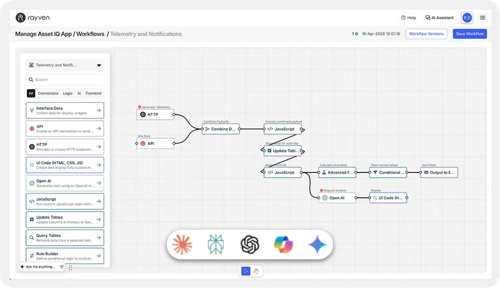
Convert, clean, enrich + reshape any data as it moves through the platform using JavaScript nodes, function nodes + schema mapping - without separate ETL tools.
Learn more →File Parsing
Extract structured data from PDFs, Word docs, CSVs, emails + more - automatically. Use AI-powered extraction + regex rules ingestion.
Learn more →Calculation + Aggregation
Compute metrics across your data sets. Sum, average, count + aggregate in real-time, as part of any workflow.
Learn more →AI Models + Training
Build, train + deploy machine learning models on your live data - directly in the platform, with predictions feeding into workflows + alerts.
Learn more →Data Storage
MySQL for structured relational records + Cassandra for high-frequency time-series events. Unified in one platform, with no ETL pipeline between them.
Learn more →PROBLEMS THE DATA LAYER SOLVES
Data challenges we solve every day.
We breakdown the same frustrating barriers that come up time and again, including:
Data trapped in silos
Data lives in disconnected systems with no way to combine or compare it, leaving decisions based on incomplete pictures.
No single source of truth
Teams work from different numbers pulled from different systems, so reporting takes hours and meetings start with debates instead of actions.
Raw data, no context
Sensor readings arrive as numbers without units, hierarchy, or business meaning. Analysts spend hours adding context before analysis can start.
Transformation work that never ends
Teams spend most of their time cleaning, reshaping + moving data - not building. Without a structured transformation layer, that cost compounds with every new source added.
AI projects blocked at the data stage
Models can't be trained on dirty, incomplete, or inconsistent data. Most AI initiatives stall before they start, not because of the model, but because the data layer isn't ready.
Files that can't be queried
CSV exports, Excel reports, JSON dumps - critical data locked in files that no dashboard can read and no workflow can act on, until someone manually processes them.
FAQs
Rayven Data Layer FAQs.
The questions CTOs, IT leaders + transformation directors ask most often about our Data Layer.
What is the Rayven Data Layer?
The Data Layer is Layer 2 of the 5-layer Rayven Platform stack. It sits directly above the Integration Layer and is responsible for storing, transforming, contextualising, and governing all operational data that enters the platform. It provides the unified, queryable data foundation that every layer above it - analytics, AI, automation, and dashboards - depends on.
How does Rayven store and manage time-series operational data?
Rayven uses a native time-series data store optimised for high-frequency sensor and operational data. It supports efficient compression of repetitive industrial readings, configurable downsampling for different retention tiers, and fast range queries over millions of data points. Time-series data is stored alongside event, transactional, and document-style data in a unified model.
What data transformation capabilities does the Data Layer include?
The Data Layer includes a full transformation engine that can clean, normalise, aggregate, filter, join, and enrich data either at ingestion (real-time streaming transforms) or on-demand (batch). Transformation rules are configured in the platform without custom code and can be versioned, audited, and reused across multiple data flows.
How does Rayven create a unified data model from multiple sources?
When data arrives from different source systems, the Integration Layer routes it into the Data Layer where a unified schema maps each field to a common data model. Asset identifiers, timestamps, units of measure, and business hierarchy fields are standardised across all sources - so a temperature reading from a SCADA system and one from an IoT device are stored and queried identically.
What data quality and validation features are available?
Data quality rules can be applied at ingestion or as standing quality checks on stored data. This includes range validation (flagging values outside expected bounds), completeness checks (detecting missing fields or gaps in time-series), deduplication, and statistical anomaly detection. Records that fail quality checks can be quarantined, flagged, or routed to a review queue rather than silently dropped.
What is data contextualisation and why does it matter for industrial operations?
Contextualisation is the process of enriching raw operational data with the business meaning that makes it interpretable. A raw sensor value becomes useful when it is tagged with the asset it measures, the site it belongs to, the engineering unit it represents, and the business process it relates to. Rayven applies contextualisation rules at the Data Layer so every consumer - dashboards, workflows, AI models - receives pre-enriched data without needing to rediscover context each time.
Does Rayven support master data management?
Yes. Rayven includes master data management (MDM) capabilities that allow you to define and maintain reference data sets - assets, locations, product codes, personnel, equipment hierarchies, and more. MDM records can be used to automatically enrich incoming operational data and to drive consistent naming and classification across reports and dashboards and workflows.
How does the Data Layer relate to the Integration Layer below it?
The Integration Layer (Layer 1) handles ingestion - collecting data from external sources and routing it into the platform. The Data Layer (Layer 2) handles everything that happens to data once it is inside: storage, transformation, contextualisation, quality management, and governance. The Integration Layer feeds the Data Layer; the Data Layer feeds everything above it. They are designed as complementary layers with clean separation of concerns.
Can we query and export data from the Data Layer directly?
Yes. The Data Layer exposes a queryable interface accessible to all Rayven modules and to authorised external tools via the API layer. You can run ad-hoc queries, schedule data exports to file or external systems, and connect third-party BI tools directly. All queries are governed by the same access control rules as the rest of the platform.
How long can Rayven retain operational data, and is it cost-efficient at scale?
Rayven supports configurable data retention policies, including hot (full resolution), warm (downsampled), and cold (archive) tiers with automatic migration between them. Retention periods are configured per data type and business requirement. Industrial-scale retention is efficient by design - time-series compression and tiered storage mean you can retain years of sensor data without the cost of storing it all at full resolution.
If you've been told 'our data is a mess', talk to us.
We'll show you what becomes possible once every system, team + tool has the data it needs, when it needs it.
Join the Shift
Discover the easy way to do something new.
Book a free 30 minute assessment with our team and we'll scope your project, needs + what a solution might look like.