What is a Weather Station IoT solution?
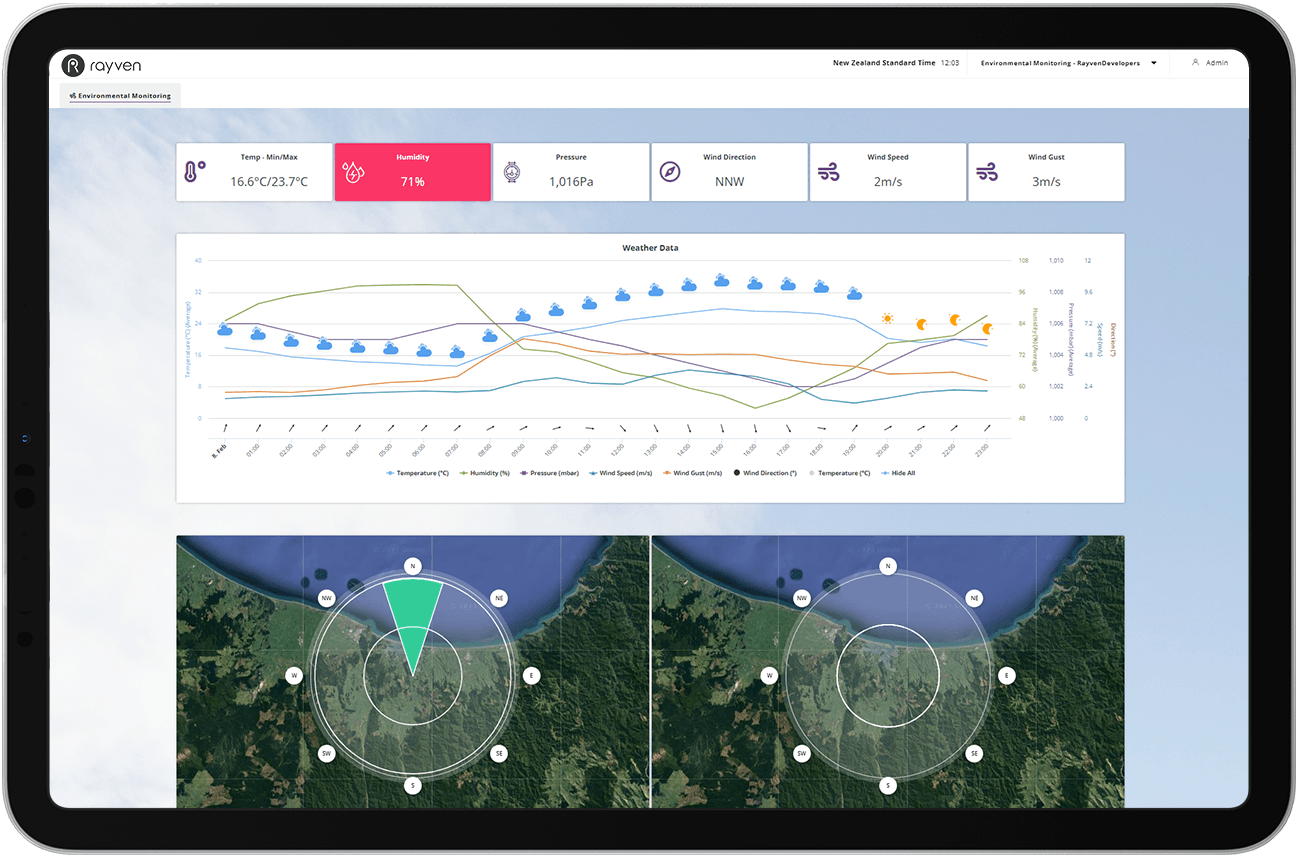
A Weather Station IoT solution uses meteorological sensors and real-time data to continuously measure atmospheric conditions including temperature, humidity, rainfall, wind speed and direction, barometric pressure and solar radiation. Rayven's IoT platform centralises all weather data, delivers threshold alerts and supports automated reporting for environmental compliance, operations planning and safety management.
What parameters can a Weather Station IoT solution measure?
The solution measures temperature, humidity, dew point, rainfall intensity and accumulation, wind speed, wind direction, barometric pressure, solar radiation, UV index and visibility. Multi-parameter sensors can be combined with soil moisture, water level and air quality sensors to create comprehensive environmental monitoring networks.
How does real-time weather monitoring improve operational safety?
Automated threshold alerts notify site managers when wind speeds, temperature or storm conditions approach safety limits, enabling proactive decision-making on work scheduling, equipment operation and evacuation procedures. Continuous data replaces periodic manual checks and removes reliance on generic Bureau of Meteorology forecasts for site-specific conditions.
Can the solution connect to existing weather instruments and systems?
Yes. Rayven's Integration Layer connects to most commercial weather station brands and protocols including Modbus, MQTT, REST API and proprietary formats. Existing on-site instruments can be retained and supplemented with additional sensors to expand monitoring coverage.
Can weather stations operate in remote locations without fixed infrastructure?
Yes. Rayven supports cellular and satellite connectivity for weather stations in remote mining sites, agricultural areas and infrastructure corridors without fixed network access. Solar-powered stations operate autonomously with local data buffering during connectivity gaps.
How does the solution support regulatory compliance and reporting?
The platform creates a continuous, timestamped log of all weather readings, ready for submission to environmental regulators, insurers and project managers. Automated reports can be generated for EPA licence conditions, construction management plans and environmental monitoring programmes on demand or on schedule.
How quickly can a Weather Station IoT solution be deployed?
Most clients go live in 2-12 weeks. Rayven's pre-built weather monitoring components cover the majority of the build, with sensor selection, threshold configuration and dashboard layout customised to your specific operational and reporting requirements.
What industries use Weather Station IoT solutions?
Weather monitoring is used in mining, construction, agriculture, water utilities, local councils, renewable energy, ports and aviation. Any operation where weather conditions affect safety, productivity or regulatory compliance benefits from site-specific real-time weather monitoring.
What alerts can be configured for weather conditions?
Threshold alerts can be configured for any parameter - for example, wind speed exceeding 72 km/h for crane operations, rainfall intensity triggering stormwater overflow risk, or temperature thresholds for worker heat stress management. Alerts are delivered via SMS, email or push notification within seconds of a breach.
How does Rayven's Weather Station solution cost less than enterprise alternatives?
Rayven charges a flat subscription with no per-sensor or per-station fees, uses pre-built weather monitoring components to reduce implementation time, and avoids specialist consultancy mark-ups. Automated reporting replaces labour-intensive manual data compilation. Book a demo to compare.





































/Website%202026/Partner%20+%20Tech%20Logos/Integration-mulesoft.webp) Integration
Integration/Website%202026/Partner%20+%20Tech%20Logos/storage-snowflake.webp) Storage
Storage/Website%202026/Partner%20+%20Tech%20Logos/Streaming-Confluent.webp) Streaming
Streaming/Website%202026/Partner%20+%20Tech%20Logos/workflow-zapier.webp) Workflow
Workflow/Website%202026/Other%20Pages/Bubble-alt.png) App Dev
App Dev/Website%202026/Partner%20+%20Tech%20Logos/Data-Lake-Databricks.webp) Data Lake
Data Lake/Website%202026/Partner%20+%20Tech%20Logos/Visualization-PowerBI.webp) Visualization
Visualization/Website%202026/Partner%20+%20Tech%20Logos/IoT-ML-AWS.webp) IoT / ML
IoT / ML/Website%202026/Partner%20+%20Tech%20Logos/Security-Crowdstrike.webp) Security
Security


/Website%202026/Industries%202026/Construction%20+%20Infrastructure/Construction%20+%20Infrastructure%20Tech%20Logos/Siemens-logo-300.webp)
/Website%202026/Industries%202026/Energy,%20Utilities%20+%20Water/Energy,%20Utilities%20+%20Water%20Tech%20Logos/ABB-logo-300.webp)
/Website%202026/Industries%202026/Facility%20Management/Facility%20Management%20Tech%20Logos/Rockwell_Automation_logo-300.png)
/Website%202026/Industries%202026/Construction%20+%20Infrastructure/Construction%20+%20Infrastructure%20Tech%20Logos/Honeywell_logo-300.webp)
/Website%202026/Industries%202026/Energy,%20Utilities%20+%20Water/Energy,%20Utilities%20+%20Water%20Tech%20Logos/Schenider-electric.png)
/Website%202026/Industries%202026/Energy,%20Utilities%20+%20Water/Energy,%20Utilities%20+%20Water%20Tech%20Logos/ecostruxurelogo-300.png)
/Website%202026/Industries%202026/Energy,%20Utilities%20+%20Water/Energy,%20Utilities%20+%20Water%20Tech%20Logos/Aveva-logo-300.webp)
/Website%202026/Industries%202026/Energy,%20Utilities%20+%20Water/Energy,%20Utilities%20+%20Water%20Tech%20Logos/GE-logo-300.webp)

/Website%202026/Industries%202026/Mining/Mining%20Tech%20Logos/IBM-logo-300.webp)
/Website%202026/Industries%202026/Energy,%20Utilities%20+%20Water/Energy,%20Utilities%20+%20Water%20Tech%20Logos/OSIsoft-logo-300.png)
/Website%202026/Industries%202026/Energy,%20Utilities%20+%20Water/Energy,%20Utilities%20+%20Water%20Tech%20Logos/IgnitionLogo-300.png)
/Website%202026/Industries%202026/Energy,%20Utilities%20+%20Water/Energy,%20Utilities%20+%20Water%20Tech%20Logos/Hitachi-logo-300.png)
/Website%202026/Industries%202026/Construction%20+%20Infrastructure/Construction%20+%20Infrastructure%20Tech%20Logos/Samsara-logo-300.png)
/Website%202026/Industries%202026/Construction%20+%20Infrastructure/Construction%20+%20Infrastructure%20Tech%20Logos/CAT-VisionLink-logo-300.png)
/Website%202026/Industries%202026/Construction%20+%20Infrastructure/Construction%20+%20Infrastructure%20Tech%20Logos/Komtrax-logo-300.png)

/Website%202026/Industries%202026/Construction%20+%20Infrastructure/Construction%20+%20Infrastructure%20Tech%20Logos/Trimble_Logo-300.png)
/Website%202026/Industries%202026/Construction%20+%20Infrastructure/Construction%20+%20Infrastructure%20Tech%20Logos/Xylem_Logo-300.png)
/Website%202026/Industries%202026/Energy,%20Utilities%20+%20Water/Energy,%20Utilities%20+%20Water%20Tech%20Logos/Taggle-logo-300.png)
/Website%202026/Industries%202026/Energy,%20Utilities%20+%20Water/Energy,%20Utilities%20+%20Water%20Tech%20Logos/itron-logo-300.png)
/Website%202026/Industries%202026/Energy,%20Utilities%20+%20Water/Energy,%20Utilities%20+%20Water%20Tech%20Logos/landis-gy-logo-300.png)
/Website%202026/Industries%202026/Energy,%20Utilities%20+%20Water/Energy,%20Utilities%20+%20Water%20Tech%20Logos/Elster-logo-300.webp)
/Website%202026/Industries%202026/Manufacturing/Manufacturing%20Tech%20Logos/fiix-logo-300.webp)
/Website%202026/Industries%202026/Facility%20Management/Facility%20Management%20Tech%20Logos/MEXLogo-300.png)
/Website%202026/Industries%202026/Energy,%20Utilities%20+%20Water/Energy,%20Utilities%20+%20Water%20Tech%20Logos/Damastra-logo-300.png)
/Website%202026/Industries%202026/Energy,%20Utilities%20+%20Water/Energy,%20Utilities%20+%20Water%20Tech%20Logos/SAP-logo-300.webp)
/Website%202026/Industries%202026/Mining/Mining%20Tech%20Logos/Oracle-Logo-300.webp)








/Website%202026/Industries%202026/Facility%20Management/Facility%20Management%20Tech%20Logos/QuickBooks-300.png)






/Website%202026/Industries%202026/Manufacturing/Manufacturing%20Tech%20Logos/Outlook-Emblem-300.png)