




















Platform > Execution Layer > Control + Automation
Control + automation.
Turn data into action, automatically - control connected devices, systems + machinery in real-time based on what your data tells you, without writing a line of code.


CAPABILITY OVERVIEW
From data event to automated action, instantly.
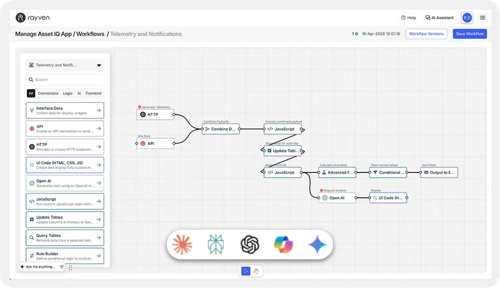
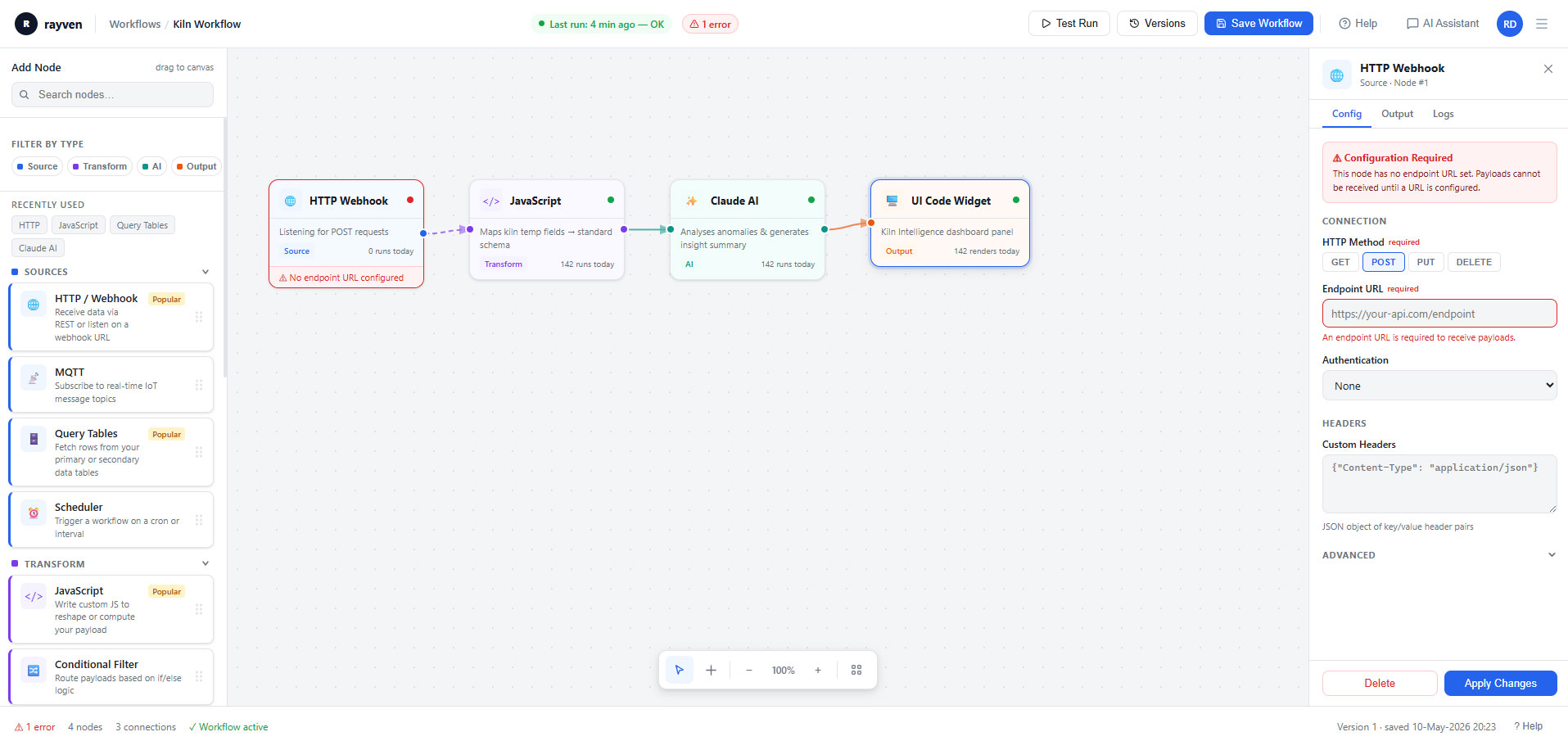
Rayven's control + automation capabilities sit at the end of every workflow chain - the execution stage where logic becomes action.
When a condition is met, a threshold breached, or a prediction triggers a rule, Rayven fires the configured output immediately.
Write control commands to Modbus-connected PLCs, publish MQTT messages to device brokers, call external APIs, send alerts, update databases + trigger downstream workflows - all from a single, no-code workflow chain.
Workflows can be triggered by:
Threshold breach events
Condition-based rule triggers (Conditional Filter + Rule Builder)
ML model prediction outputs
Schedule or cron-triggered workflows
External system events (webhooks, API POST)
Manual dashboard control actions
Workflow outputs can be:
Output to Modbus (write coil or register to device)
Output to MQTT (publish to broker)
Output to HTTP (webhook or API call)
Output to Email + SMS
Update Tables (database writes)
Trigger downstream workflows
KEY CAPABILITIES
What Control + Automation gives you.
Logic-based rule automation
Configure IF-THEN automation rules using the Rule Builder node - no code required. Define conditions using AND/OR logic, assign outcomes to payload fields + chain to output nodes. Handles threshold alerts, status changes, multi-condition evaluations + cross-device logic in the same workflow.
Direct device + system control
Write control commands directly to connected devices and systems via Output to Modbus, Output to MQTT, Output to HTTP + Output to API nodes. Close the loop from ingested sensor data to physical control action within a single workflow execution - without external middleware.
Virtual controls on dashboards
Add button, dropdown + text field widgets to any dashboard, enabling operators to trigger workflow actions manually from an interface. Virtual controls create app-like interfaces where users send commands to connected systems directly from their browser, without leaving the platform.
Closed-loop + self-optimising automation
Chain ML model prediction nodes with control output nodes to create self-optimising feedback loops. The model scores incoming data, the Rule Builder evaluates the prediction, and the Output node fires a control command or adjustment - without human intervention at any step.
Escalation + fallback handling
Configure multi-step escalation paths for when primary actions fail or conditions persist beyond a defined window. Fallback routes, retry logic, dead-letter queues + circuit breakers ensure automation is resilient - not a single point of failure.
Audit trail + governance
Every automated action is stored in Cassandra with full payload context, timestamp + operator notes. Rate limiting, guardrails, simulation/dry-run mode, idempotency keys + rollback/compensation patterns are available for high-consequence automation scenarios.
HOW IT CONNECTS: EXPLAINER
Where Control + Sutomation fit in the Rayven Platform stack.
Control + automation nodes sit at the output end of the Execution Layer - the stage where all upstream processing, logic + AI evaluation results in a real-world action.
-
Data arrives from the Integration + Data Layers via workflow triggers.
-
Logic nodes (Conditional Filter, Rule Builder, JavaScript) evaluate the data.
-
Control + output nodes fire the configured action - device command, API call, alert, database write.
-
The Presentation Layer reflects the outcome in dashboards + reports.
Every action is logged in Cassandra for audit + observability.
USE CASES
How Control + Automation gets used.
Closed-loop industrial control from sensor to PLC
A vibration sensor streams readings via MQTT. A per-asset workflow evaluates each reading against a threshold using a Rule Builder node. If breached, Output to Modbus writes a speed-reduction command directly to the connected PLC + Output to SMS notifies the maintenance team. The entire loop - ingest, evaluate, control - completes in milliseconds.
Automated customer action from CRM event
A CRM webhook fires when a contract expires. A Conditional Filter evaluates whether a renewal offer applies. If yes, an Output to Email sends a personalised renewal prompt; a Query Tables node pulls the account manager's details + Output to SMS sends them a follow-up task. No manual monitoring required.
Partner automating multi-client operational responses
An MSP configures per-Label automation workflows for multiple clients. Each client's threshold conditions + output actions are defined independently. When a condition fires for any client, the workflow routes the correct action to their specific systems + contacts - with Label-based isolation ensuring no cross-client data or action bleed.
Rayven Control + automation FAQs:
What control output protocols does Rayven support?
Output to Modbus (coil/register writes), Output to MQTT (publish to any broker), Output to HTTP, SQL write, FTP output and Output to AMQP. All are available as workflow nodes. Combine with Integration Layer inputs for full closed-loop control. See IoT Devices + Protocols.
Can Rayven automate a decision based on real-time sensor data?
Yes. A sensor reading triggers the workflow, a Conditional Filter evaluates it against a threshold, and an output node fires a control command or alert within the same execution chain - typically within seconds of the data arriving. See Real-time Data Processing.
Can automation logic combine data from multiple sources before acting?
Yes. A workflow can ingest from multiple sensors, query a database, call an AI model and then evaluate all outputs before deciding whether to act. Multi-source logic gates are standard workflow design. Explore Workflows + Triggers.
Can Rayven write to a Modbus-connected PLC?
Yes. The Output to Modbus node writes coil states or register values to any Modbus TCP/RTU-connected device. This supports direct actuation of PLCs, VFDs and relay controllers from within the Rayven workflow. See IoT Devices + Protocols.
Can Rayven trigger an alert AND a physical action at the same time?
Yes. A single workflow branch can simultaneously fire an SMS alert via the Notification node and send a Modbus write command. Multiple output nodes operate in parallel within the same execution. See Notifications + Alerts.
Is there approval logic for critical automated actions?
Yes. The Approvals module adds human-in-the-loop checkpoints before high-risk actions execute. An approval request is sent to a designated user; the workflow pauses until confirmed or times out. See Approvals + Exceptions.
Can automation rules be updated without stopping the workflow?
Yes. Rule Builder and Conditional Filter parameters can be updated in the workflow builder. Changes take effect on the next trigger cycle without requiring a workflow restart. Explore Workflows + Triggers.
Can Rayven automate actions on a schedule (e.g. nightly batch)?
Yes. Scheduled triggers run automation workflows at any configured interval - every minute, hourly, daily, weekly or custom cron expression. Scheduled and event-driven automation can run in parallel on the same platform. See Workflows + Triggers.
Can automation logic use AI predictions as inputs?
Yes. A deployed ML model or LLM node can score incoming data and its output feeds the Conditional Filter that decides whether to act. AI-driven automation is a native Rayven pattern. See Predictive AI / Machine Learning.
How many concurrent automation workflows can run simultaneously?
The platform handles thousands of concurrent workflow instances. Each UID runs its own independent execution - large asset fleets firing simultaneously is a standard deployment. Contact us for specific throughput requirements.
Also in the Execution Layer:
Workflows + Triggers
Schedule, event, threshold + API triggers that initiate any workflow automatically or on demand across the platform.
Predictive AI / Machine Learning
Deploy Python ML models as workflow nodes - scoring live data and triggering threshold-based actions in real-time.
Gen AI + AI Agents
Chain LLM connector nodes within workflows for document extraction, classification, summarisation + agent-style automation.
Approvals + Exceptions
Build human-in-the-loop approval steps, exception routing + escalation logic into any workflow chain.
Rayven MCP
Give AI assistants like Claude, ChatGPT + Gemini governed, real-time access to your contextualised operational data via the Model Context Protocol.
Ready to automate?
Show us the process you want to automate and we will walk you through how Rayven handles it - from trigger to action.
Join the Shift
Discover the easy way to do something new.
Book a free 30 minute assessment with our team and we'll scope your project, needs + what a solution might look like.