





















Platform > Execution Layer > Gen AI + AI Agents
Gen AI + AI agents.
Build and deploy generative AI into your operations - custom LLMs trained on your data, AI agents that act + conversational interfaces that turn questions into outcomes.


CAPABILITY OVERVIEW
AI that works in your operations, not alongside them.
Rayven's GenAI capabilities go beyond chat interfaces.
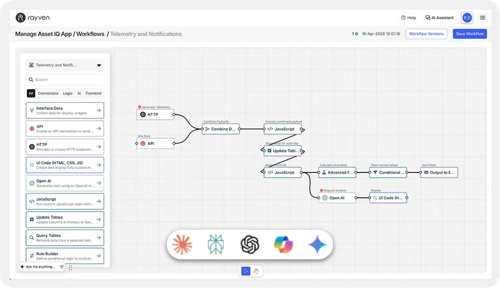
LLM connector nodes operate within workflow chains - processing documents, extracting structured data, generating outputs + triggering automated actions -with custom LLMs trained directly on your data in real-time.
AI agents operate with full governance controls - prompt management, memory limits + policy-aware actions. Conversational analytics interfaces embed into your dashboards, enabling users to ask questions about live data in plain English and trigger workflow actions from the response.
Workflows can be triggered by:
-
Live operational data from workflows (context for LLM nodes)
-
Document + files for AI processing
-
Natural language user queries (from conversational interfaces)
-
Primary Table + Cassandra data (for RAG context)
-
Workflow payloads from upstream nodes
Workflow outputs can be:
Structured extracted data for storage + downstream workflow steps
Natural language insights surfaced in dashboard interfaces
Policy-aware automated actions triggered by AI agent responses
AI-generated reports, summaries + recommendations
KEY CAPABILITIES
What Gen AI + AI Agents give you.
LLM connector nodes in workflows
Chain LLM connector nodes (OpenAI, Claude, Gemini, Cohere, Mistral, Llama, Copilot, IBM Granite) at any point in a workflow. Each node accepts dynamic inputs from upstream nodes - passing documents, structured data or operational context to the model and routing its output to downstream logic, storage, or interface nodes. Multiple AI nodes can operate in the same workflow.
Custom LLMs trained on your data
Build and deploy custom LLMs trained on your organisation's operational data, documents + historical records using Rayven's LLMOps capabilities. Custom models deliver insights and responses grounded in your specific context - not generic web knowledge. Train, update + redeploy as your data grows.
AI agents with governance + policy controls
Build AI agents that sit over your unified operational data and take configurable actions - raise work orders, generate compliance packs, route approvals + query systems on demand. Each agent runs with full governance controls: prompt management, memory limits, rate controls + policy-aware action constraints.
Conversational analytics interface
Embed conversational query interfaces into any dashboard or application interface. Users ask questions about live operational data in plain English and receive accurate, context-aware answers + insights. Interfaces are trained on your data - not a generic model - ensuring responses are relevant to your operations.
Retrieval-augmented generation (RAG)
Ground LLM responses in your actual operational data using RAG over Cassandra + MySQL. The model retrieves relevant context from your data layer before generating a response - improving accuracy, reducing hallucination risk + ensuring answers are based on current, governed information.
GenAI-driven workflow automation
Configure workflows where an LLM node evaluates incoming data, determines the appropriate action based on a configured prompt + policy set, and triggers the output automatically. AI decides what action to take - routing, escalation, approval, notification - without a hardcoded rule for every scenario.
HOW IT CONNECTS: EXPLAINER
Where Gen AI + AI Agents fit in the Rayven Platform stack.
Gen AI + AI Agents sit in the Execution Layer as the generative intelligence stage of workflows - evaluating, interpreting + generating outputs based on operational data.
-
Data from the Integration + Data Layers flows into LLM nodes as context or processing inputs.
-
LLM node outputs pass to downstream logic nodes, output nodes, storage + presentation widgets.
-
AI agent actions connect to all output capabilities - write to systems, trigger workflows, send alerts, control devices.
-
The Presentation Layer embeds conversational interfaces into dashboards + custom applications.
All LLM interactions are governed by prompt controls, memory limits + audit logging within the platform.
USE CASES
How Gen AI + AI Agents get used.
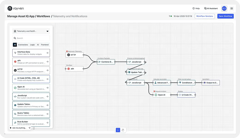
AI-powered document processing pipeline for operations
Maintenance reports and inspection forms arrive as PDFs in an SFTP folder. A Rayven workflow passes each document to a Claude node with a structured extraction prompt. Extracted fields - asset ID, fault description, severity classification - write to a Secondary Table. If severity is critical, the workflow triggers a work order + sends an alert. Fully automated from document arrival to action.
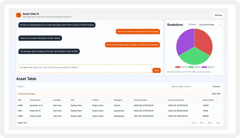
Conversational analytics for a real-time operations dashboard
An operations team embeds a conversational interface into their Rayven dashboard. The interface is trained on live asset performance data, maintenance history + KPI targets. Operators ask questions in plain English - 'Which assets are at risk this week?' - and receive accurate, context-specific answers grounded in current operational data.
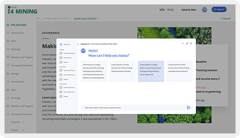
Partner delivering a governed AI agent as a client-facing product
An MSP builds a policy-aware AI agent for a facilities management client. The agent sits over the client's maintenance + compliance data. It can answer queries, raise work orders + generate compliance summaries on demand - operating within configured policy limits and audit logging every action. Delivered as the partner's own AI product.
Rayven Gen AI + AI Agents FAQs:
Which LLM providers does Rayven support as workflow nodes?
OpenAI (GPT-4 and GPT-4o), Anthropic Claude, Google Gemini, Cohere, Mistral, Meta Llama, Microsoft Copilot and IBM Granite. Each is a configurable workflow node - no custom API code required. See AI Connectors.
Can I send operational data from Rayven directly to an LLM?
Yes. Any data available in the workflow - sensor readings, database records, form submissions, file content - can be structured as a prompt and sent to any connected LLM node. The response feeds downstream workflow nodes. See Real-time Data Processing.
Can LLMs generate reports from Rayven data automatically?
Yes. A scheduled workflow can pull aggregated data, format it into a structured prompt, send it to an LLM for narrative generation, and output a formatted report to email, a dashboard or an external system. See Calculation + Aggregation.
What is an AI agent in the Rayven context?
An AI agent in Rayven is a multi-step workflow where an LLM makes decisions, calls tools (API nodes, data reads, output actions) and iterates based on results - all within the workflow builder. No external agent framework is required. Explore all Execution Layer capabilities.
Can a Gen AI workflow trigger a physical action?
Yes. An LLM output feeds into a Conditional Filter or directly into output nodes - SMS alert, MQTT publish, API call, database write. The same pipeline that handles rule-based automation also handles AI-driven decisions. See Control + Automation.
How are prompts managed and versioned?
Prompt templates are configured within the LLM workflow node. Changes are managed in the workflow builder with version control. Prompts can include dynamic data injected at runtime from upstream workflow nodes. Explore Workflows + Triggers.
Can Rayven combine a custom ML model with an LLM in the same workflow?
Yes. A Python ML model node can score structured data first; the LLM node then generates a natural language explanation, recommendation or action plan based on the score. See Predictive AI / Machine Learning.
Can LLM outputs be stored and queried later?
Yes. LLM output text can be written to a Secondary Table, a Cassandra record or returned via an API endpoint. Historical LLM outputs are queryable like any other stored data. See Unified Data Tables.
Is RAG (Retrieval Augmented Generation) supported?
Yes. Rayven data stored in Primary and Secondary Tables can be retrieved by UID within the workflow and injected into the LLM prompt as context. This provides grounded, entity-specific generation without a separate vector database. See Data Management.
Can a Gen AI workflow include an approval step before acting?
Yes. An LLM can generate a proposed action; the workflow pauses for human review via the Approvals module before executing. This keeps humans in the loop on AI-generated decisions in high-stakes processes. See Approvals + Exceptions.
Also in the Execution Layer:
Control + Automation
Write control commands to connected devices, systems + machinery - closing the automation loop from data to action.
Predictive AI / Machine Learning
Deploy Python ML models as workflow nodes - scoring live data and triggering threshold-based actions in real-time.
Workflows + Triggers
Schedule, event, threshold + API triggers that initiate any workflow automatically or on demand across the platform.
Approvals + Exceptions
Build human-in-the-loop approval steps, exception routing + escalation logic into any workflow chain.
Rayven MCP
Give AI assistants like Claude, ChatGPT + Gemini governed, real-time access to your contextualised operational data via the Model Context Protocol.
Ready to automate?
Show us the process you want to automate and we will walk you through how Rayven handles it - from trigger to action.
Join the Shift
Discover the easy way to do something new.
Book a free 30 minute assessment with our team and we'll scope your project, needs + what a solution might look like.