Go beyond the widget library - inject custom HTML, CSS + JavaScript into any interface to build bespoke visualizations, custom interactions + fully tailored user experiences.
CAPABILITY OVERVIEW
Full code control, inside the platform.
Rayven's HTML + JavaScript capability removes the ceiling on interface customisation.
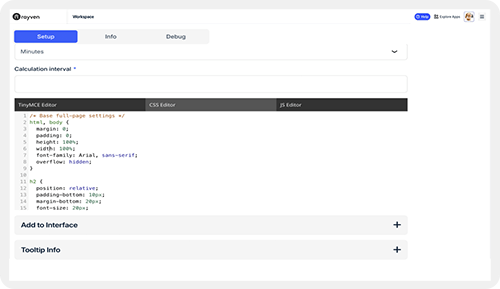
Any widget, dashboard panel or application screen accepts custom HTML, CSS + JavaScript injection - enabling bespoke visualisations, dynamic form interactions, third-party library integrations + fully custom layouts that aren't achievable with the standard widget library.
Code execution is sandboxed, governed + audited. Dynamic variables pull live data from workflows directly into HTML content. Bidirectional data flow means custom UIs can both display live data and push user input back to workflows.
Data sources feeding dashboards include:
Cassandra time-series data via dynamic variables in HTML content
Primary + Secondary Table records (MySQL) via workflow node outputs
Workflow execution results passed as variables to HTML nodes
External API responses injected into custom interface elements
Outbound connections include:
Custom HTML form submissions routing data back into workflows
JavaScript-triggered workflow events via control interactions
Dynamic data pushed from HTML nodes to downstream workflow steps
KEY CAPABILITIES
What HTML + JavaScript gives you.
Custom HTML widgets
Inject custom HTML + CSS into any widget slot on a dashboard or application screen. Build bespoke table layouts, specialised data displays, branded UI components + custom navigation elements that go beyond the standard widget configurations. Custom HTML renders alongside standard widgets on the same page.
JavaScript logic + interactivity
Write custom JavaScript to create dynamic, interactive interface elements - sliders, custom dropdowns, data-driven conditional displays + animated visualisations. JavaScript executes within a sandboxed environment with role-based access, secrets management + audit logging.
Third-party library integration
Import approved external JavaScript libraries directly into HTML + JS nodes - chart libraries, mapping frameworks, physics engines, interaction toolkits + more. Extend Rayven's interface capabilities with any front-end library without building a separate application.
Dynamic variables + live data injection
Pull real-time data from workflow nodes directly into HTML content using dynamic variables. Display current sensor readings, calculated metrics, ML predictions + table records within custom HTML elements - updating automatically on each workflow refresh cycle.
Bidirectional data flow
Custom HTML forms + interactive elements can push data back into Rayven workflows. User inputs, control interactions + form submissions from custom HTML interfaces route directly into workflow chains - maintaining the same data governance + audit trail as standard form widgets.
Sandboxed execution + governance
All HTML + JavaScript execution runs in a sandboxed environment. Code is logged, access is governed by role-based permissions, secrets are managed securely + all interactions are included in the platform audit trail. Custom code gets full capability without bypassing platform governance.
HOW IT CONNECTS: EXPLAINER
Where HTML + JavaScript fit in theRayven Platform stack.
HTML + JS nodes sit in the Presentation Layer as a code-level extension of the widget library.
Live data flows from the Data Layer + Execution Layer into HTML nodes as dynamic variables.
Custom HTML interfaces render within the same dashboard + application screens as standard widgets.
User inputs from custom HTML forms route back through the Execution Layer as workflow triggers.
All code execution is governed, sandboxed + audited within the platform's security framework.
Custom real-time asset status display for a mining operator
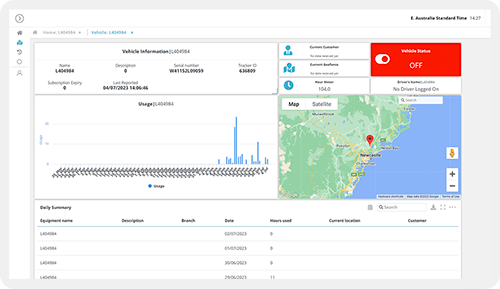
An operator needs a bespoke asset health visualisation - a colour-coded grid showing all 500 assets with status, last reading + predicted maintenance date - that the standard table widget can't replicate. An HTML + JS node injects a custom grid component pulling live Cassandra data as dynamic variables. The grid renders within the existing dashboard alongside standard KPI widgets.
Interactive data entry form for a field services team
A field services firm needs a form with conditional logic, custom validation + a signature capture field that the standard form builder doesn't support. An HTML + JS node builds the custom form with JavaScript-driven conditional display, canvas-based signature capture + client-side validation. On submission, the data routes back into the Rayven workflow chain via bidirectional data flow.
Partner embedding a third-party mapping SDK into a client portal
An MSP needs to embed a specialised logistics mapping SDK into a client portal to display route optimisation overlays. An HTML + JS node imports the approved library, initialises the map with live GPS data from Cassandra + renders it within the client's branded dashboard. The integration requires zero infrastructure changes outside the platform.
Rayven HTML + JavaScript FAQs:
Can I use custom HTML and JavaScript in Rayven interfaces?
Yes. HTML and JavaScript widgets can be inserted at any position in a Rayven dashboard, form or application layout. They have access to Rayven data context and can interact with other platform components. See Widgets + UI Components.
What can custom HTML/JavaScript widgets do?
Render custom charts using third-party libraries (Chart.js, D3, Highcharts), embed external iFrames, display calculated content, implement custom interactions, apply brand-specific styling and call external APIs. Explore the full Presentation Layer.
Can custom widgets access live Rayven data?
Yes. The Rayven platform passes current data context to HTML/JavaScript widgets at render time. Widget code can access UID-specific values, table records and calculated metrics from the surrounding dashboard. See Unified Data Tables.
Is coding knowledge required to use HTML/JavaScript widgets?
Yes, for custom widget development. The rest of the Rayven interface is no-code. Standard visualisations require no coding - see Dashboards + Visualisations. HTML/JavaScript is for developers extending beyond standard components.
Can I embed a third-party map in a Rayven dashboard?
Yes. Leaflet, Google Maps, Mapbox and other JavaScript mapping libraries can be embedded via HTML/JavaScript widgets. Asset location data from Rayven tables can feed map markers dynamically. See Dashboards + Visualisations.
Are there security restrictions on custom JavaScript execution?
Yes. Custom JavaScript executes within the Rayven application context. Access to sensitive platform APIs requires appropriate role permissions. Externally loaded scripts are subject to content security policy controls. See Security.
Can custom HTML be used in Dynamic Reports?
Yes. Report templates support HTML and CSS customisation for layout, branding and content presentation. This allows reports to match organisational visual standards precisely. See Dynamic Reports.
Can custom widgets interact with workflow triggers?
Yes. A JavaScript widget can send a POST request to a Rayven inbound API endpoint, triggering a connected workflow from a user action within the interface. See API Endpoints.
Can I include external CSS frameworks in custom widgets?
Yes. External stylesheets and frameworks (Bootstrap, Tailwind, etc.) can be loaded within HTML widgets via standard link and script tags. Scoping to the widget container avoids conflicts with Rayven platform styles. See Widgets + UI Components.
Can HTML/JavaScript widgets be reused across multiple dashboards?
Yes. Custom widget templates can be saved and reused. The same widget with different data context parameters can be deployed across multiple dashboards without rewriting the underlying code. See Widgets + UI Components.