
























Platform > Execution Layer > Predictive AI / Machine Learning
Predictive AI / machine learning.
Deploy machine learning predictions into live operational workflows - turning forecasts into automated actions, alerts + decisions in real-time.


CAPABILITY OVERVIEW
Predictions that act, not just inform.
Rayven's predictive AI capabilities go beyond dashboards.
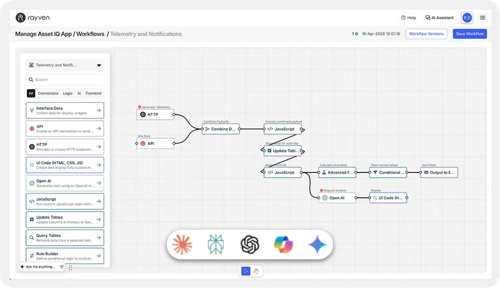
Trained ML models are deployed as workflow nodes, scoring incoming operational data in real-time. When a prediction crosses a threshold, the same workflow fires an alert, triggers a control command, updates a record, or calls an external system - all automatically.
Prediction and action are a single continuous chain, not two separate processes.
Workflows can be triggered by:
-
Live Cassandra time-series data (for real-time inference)
-
ML model prediction score outputs
-
Threshold comparison values from Rule Builder
-
Historical data for model retraining
-
Workflow payloads from upstream nodes
Workflow outputs can be:
-
Prediction-triggered alerts (email, SMS, webhook)
-
Automated control actions (Output to Modbus, MQTT)
-
ML Chart widget values for UIs
-
Prediction data to external systems via API endpoints
-
Downstream workflow triggers based on prediction scores
KEY CAPABILITIES
What Predictive AI / Machine Learning gives you.
Real-time predictive inference
Deployed ML models score incoming data as it arrives in a workflow - per-asset, in parallel, at-scale. Every prediction is available to downstream logic nodes immediately. No batch scoring, no separate inference service, no latency between data arrival and prediction output.
Anomaly detection + automated response
Configure workflows where an anomaly detection model scores a sensor reading and a Rule Builder evaluates the score against a threshold. If the prediction indicates an anomaly, an automated action fires - maintenance alert, control command, or escalation - before a failure occurs.
Closed-loop self-optimising workflows
Chain prediction outputs with control output nodes. The model predicts an optimal state; the output node adjusts the connected system accordingly. As new data arrives, the model re-evaluates and the loop self-optimises - without human intervention at any step.
Predictive analytics dashboards
Surface model predictions, confidence intervals + historical actuals in ML Chart widgets on any dashboard. Operators see forecasted outcomes alongside live operational data in one view - giving context to current performance against predicted trajectory.
Digital twin + model testing
Test ML algorithms against isolated historical data before deployment. Run multiple models in parallel against the same dataset, compare performance metrics side by side + select the best-performing model. Deploy with confidence, not guesswork.
Continuous model retraining
Cassandra accumulates operational data continuously. Models can be retrained on an updated dataset at any time - on a schedule or on-demand. As operational patterns change, models adapt. Retraining does not require rebuilding the deployment workflow.
HOW IT CONNECTS: EXPLAINER
Where Predictive AI / Machine Learning fit in the Rayven Platform stack.
Predictive AI sits in the Execution Layer as the intelligence stage of every workflow - evaluating incoming data and determining what action to take based on what the model predicts.
-
Training data comes from the Data Layer - Cassandra time-series + Primary Table records.
-
Deployed models receive live data from upstream workflow nodes + Integration Layer sources.
-
Prediction outputs pass to logic nodes (Rule Builder, Conditional Filter) for threshold evaluation.
-
Control + output nodes fire the configured automated response.
-
The Presentation Layer surfaces predictions in ML Chart widgets on dashboards.
USE CASES
How Predictive AI / Machine Learning gets used.
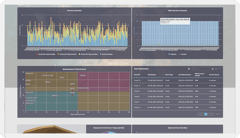
Predictive maintenance for a mining fleet
A vibration sensor streams readings from 200 pumps via MQTT. A per-asset workflow passes each reading to a deployed anomaly detection model. When predicted failure probability exceeds 85%, the workflow fires a maintenance work order to the CMMS, sends an SMS to the site supervisor + writes an event to a Secondary Table - all before any physical failure occurs.
Demand forecasting for a retail operation
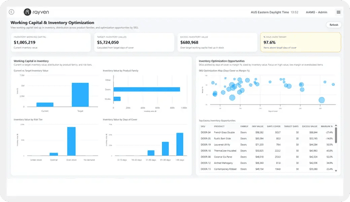
A time-series forecasting model is deployed against daily sales transaction feeds. Each day, the model generates a per-store demand forecast for the next seven days. Forecasts feed a planning dashboard + trigger automated replenishment orders for stores where predicted stock falls below threshold.
Partner delivering predictive analytics as a white-label product
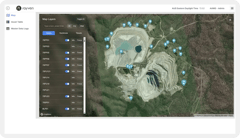
An MSP trains client-specific forecasting models within Rayven using each client's historical data. Deployed models score live client data streams and surface predictions in branded dashboards. Clients receive AI-powered operational intelligence delivered as the partner's own product.
Rayven Predictive AI / Machine Learning FAQs:
What types of predictions can Rayven ML models produce?
Regression (continuous value forecasting), classification (event categorisation), clustering (anomaly and outlier detection) and time-series forecasting. Any output a Python scikit-learn, XGBoost or statsmodels model can generate is supported. See AI Models + Training.
Does the ML model run inside the workflow in real-time?
Yes. Once published, a model is a workflow node. It receives incoming data, scores it and passes the result to the next node - within the same real-time execution chain. Latency is typically milliseconds. Explore Workflows + Triggers.
Can model outputs trigger automated actions?
Yes. A model output (probability score, class label, predicted value) feeds a Conditional Filter. If the result crosses a configured threshold, downstream nodes fire - alerts, control commands, API calls, database writes. Explore Control + Automation.
How are ML models trained within Rayven?
Models are built and trained in the Rayven ML modeller using Python and any stored Cassandra or MySQL dataset as training input. No data export is required. Training runs as a scheduled workflow. See AI Models + Training.
Can models be retrained automatically as new data arrives?
Yes. A retraining workflow can trigger on a schedule or on a data event - for example, when a labelled batch reaches a configured size. The newly trained model version is published automatically on completion. See Workflows + Triggers.
Can Rayven ML models and external LLMs run in the same workflow?
Yes. A custom Python ML model node and an OpenAI, Claude or Gemini LLM node can both be steps in the same workflow. The ML model scores structured data; the LLM generates a natural language explanation. See Gen AI + AI Agents.
What feature inputs can be used for ML model training?
Any data stored in Rayven - Cassandra time-series readings, MySQL table records, calculated aggregations, form submission data. Feature engineering is done in upstream transformation nodes. See Calculation + Aggregation.
Can predictions be stored for model performance monitoring?
Yes. Prediction outputs can be written to a Secondary Table alongside the ground truth when it becomes available. This enables model drift analysis and retraining trigger logic over time. See Unified Data Tables.
Is there support for anomaly detection?
Yes. Unsupervised clustering models (Isolation Forest, DBSCAN) are a common Rayven ML deployment. Real-time scoring of incoming sensor data against a trained anomaly model is a standard pattern - particularly for predictive maintenance. See Real-time Data Processing.
Can multiple models run in sequence in the same workflow?
Yes. Multiple model nodes can be chained - a first model filters, a second classifies, a third forecasts. Results accumulate through the chain and are available to all downstream nodes. Explore the Execution Layer.
Also in the Execution Layer:
Control + Automation
Write control commands to connected devices, systems + machinery - closing the automation loop from data to action.
Workflows + Triggers
Schedule, event, threshold + API triggers that initiate any workflow automatically or on demand across the platform.
Gen AI + AI Agents
Chain LLM connector nodes within workflows for document extraction, classification, summarisation + agent-style automation.
Approvals + Exceptions
Build human-in-the-loop approval steps, exception routing + escalation logic into any workflow chain.
Rayven MCP
Give AI assistants like Claude, ChatGPT + Gemini governed, real-time access to your contextualised operational data via the Model Context Protocol.
Ready to automate?
Show us the process you want to automate and we will walk you through how Rayven handles it - from trigger to action.
Join the Shift
Discover the easy way to do something new.
Book a free 30 minute assessment with our team and we'll scope your project, needs + what a solution might look like.